
Wedding films at Grand Hôtel, Nationalmuseum and Häringe Slott


QUICK FACTS
- Nordvér Films has filmed weddings at Grand Hôtel, Nationalmuseum and Häringe Slott, and further afield in Verbier in Switzerland and Praiano on the Amalfi Coast.
- A wedding film with Nordvér starts at around 45 000 SEK, about 4 000 EUR. In our experience a professional videographer in Sweden starts at around 35 000 SEK.
- The delivered highlight film runs 5 to 8 minutes and covers the whole arc of the day. Delivery is within 12 weeks.
- David Backlund films and edits every film himself. Handheld, natural light, documentary approach, no posing and no direction.
- Three things decide how a room films: how much daylight reaches it, how much reverberation it carries, and where a camera can physically stand without joining the ceremony.
- We take a small number of weddings each year, reply within 48 hours, and summer dates go first. Travel is written into the quote.
A venue decides what a wedding film can look like long before anyone turns a camera on, and a wedding videographer Stockholm couples hire should be able to tell you what each room will give and what it will take away. Light, ceiling height, the depth of the hall, the hardness of the surfaces and the position of the guest seating do more to the finished film than any lens or camera body. We have filmed at Grand Hôtel, at Nationalmuseum and at Häringe Slott, and each of those three buildings asks for a different way of working.
This is not a ranking and it is not a general venue guide. There is no best room, only rooms that behave differently on camera. A hall with tall windows on one side gives you soft, directional light for a few hours and then goes flat. A stone atrium gives you height and reflected light but a long tail of reverberation on every spoken word. A country house with small windows and dark panelling gives you intimacy and warmth and very little margin once the sun drops below the treeline.
What follows is what we actually work with in each of those three places: where the light comes from and how long it lasts, where a camera can stand without becoming part of the ceremony, what the sound does, and how the timeline has to bend to fit. If you are still choosing between rooms, the practical pages on wedding videographer Stockholm and wedding film across Sweden cover how we work more broadly.
Why the room changes the film more than the equipment does
Cameras have become very good at low light. That is true and it is also beside the point. A sensor that can see in a dark hall still cannot decide where the light is coming from, and direction is what makes a face look like a face rather than a flat shape. A window at head height three metres to the left of where two people are standing is worth more to the finished film than two stops of sensitivity.
The same goes for space. A film needs the camera to move, or at least to have somewhere to move to. In a room where the aisle is the only clear floor and the aisle is where the couple are walking, there is exactly one usable position and everything has to be planned around it. In a room with a gallery, a side corridor or a deep back wall, the same ceremony can be covered from three angles without anyone noticing a camera at all. That difference is structural. No amount of gear closes it.
Sound is the third axis and the one couples think about last. Hard stone, high ceilings and bare walls give you a long reverberation tail. Vows recorded in that kind of room can sound like they were spoken at the bottom of a well unless the microphones are close to the mouth rather than close to the camera. Carpet, curtains, wood panelling and a full room of guests in fabric all absorb sound and make speech easier to use in the edit.
So when a wedding videographer Stockholm couples are talking to asks what the venue is before answering anything else, that is not small talk. The answer changes the shot list, the microphone plan, the number of positions and often the timeline itself.
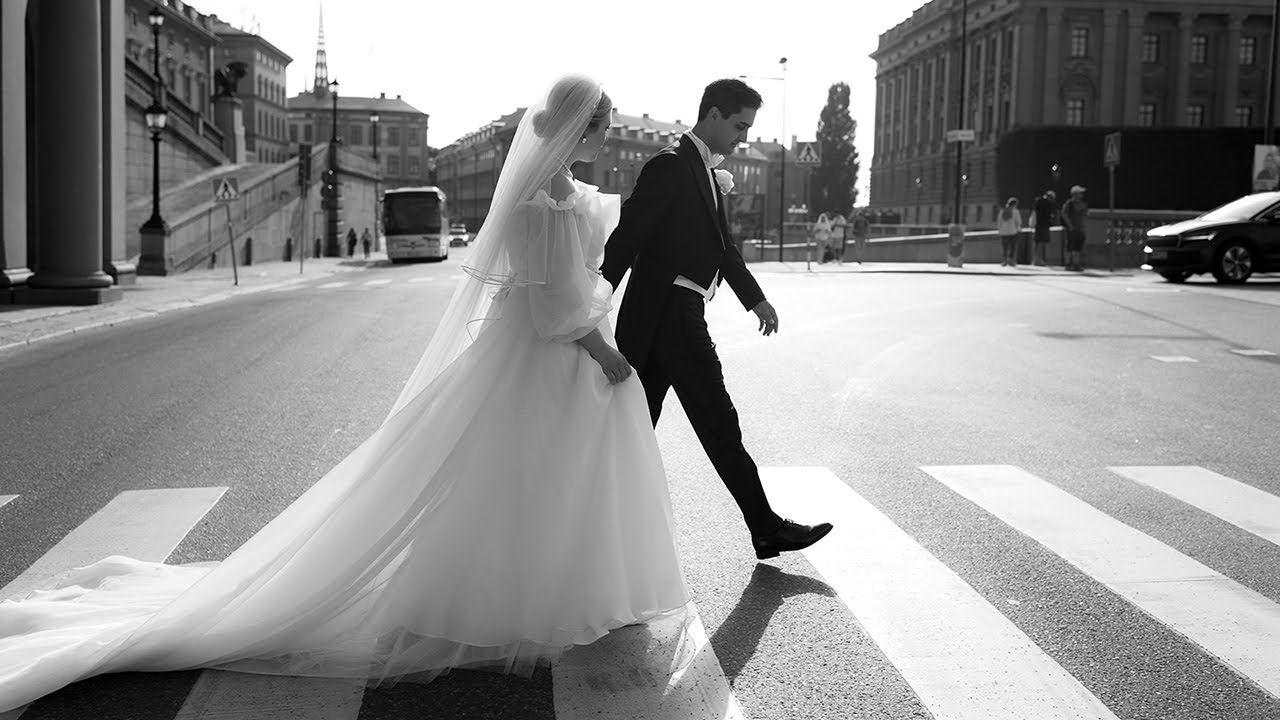
Wedding film at Grand Hôtel: window light, corridors and the water outside
Grand Hôtel sits on the water with the city on the other side of it, and that setting does two useful things for a film. The first is that the light coming in through the tall windows on the waterfront side is bounced off a large open surface before it arrives, which softens it. The second is that stepping outside puts you straight into a wide view with depth in it, so a film that has spent an hour in interiors has somewhere to open up.
Inside, the building works in a way that suits how we film. A grand hotel of this period is built around circulation: corridors, stairs, landings, a sequence of rooms that lead into each other. That means a camera can follow people between spaces instead of waiting for them to arrive, which is where most of the unposed material in a film comes from. A bride walking a corridor, a father waiting at a landing, a room seen through an open door before anyone enters it. Those are not set up. They exist because the building has thresholds.
The demanding part is contrast. Large windows in rooms with dark interiors mean that a face turned toward the glass and a face turned away from it are several stops apart. Working handheld and without added light, we solve that by placing ourselves rather than the people: shooting along the window wall instead of across it, keeping the bright rectangle behind the camera rather than behind the subject. It also means the getting-ready hours are worth scheduling near the windows, not in the middle of the room.
For ballroom dinners and speeches, the practical constraint is guest seating. Round tables fill the floor and the speaker is usually standing among them rather than on a stage, so the sightline from any fixed camera position is partly blocked by heads and glassware. We plan for that by taking a low angle from a table edge and a second position further back for the reactions, and by putting a microphone on the speaker rather than trusting the room. Any wedding videographer Stockholm couples work with at a hotel of this kind should be asking about the table plan before the day, not on it. Practical detail about the building itself is on the official Grand Hôtel site.
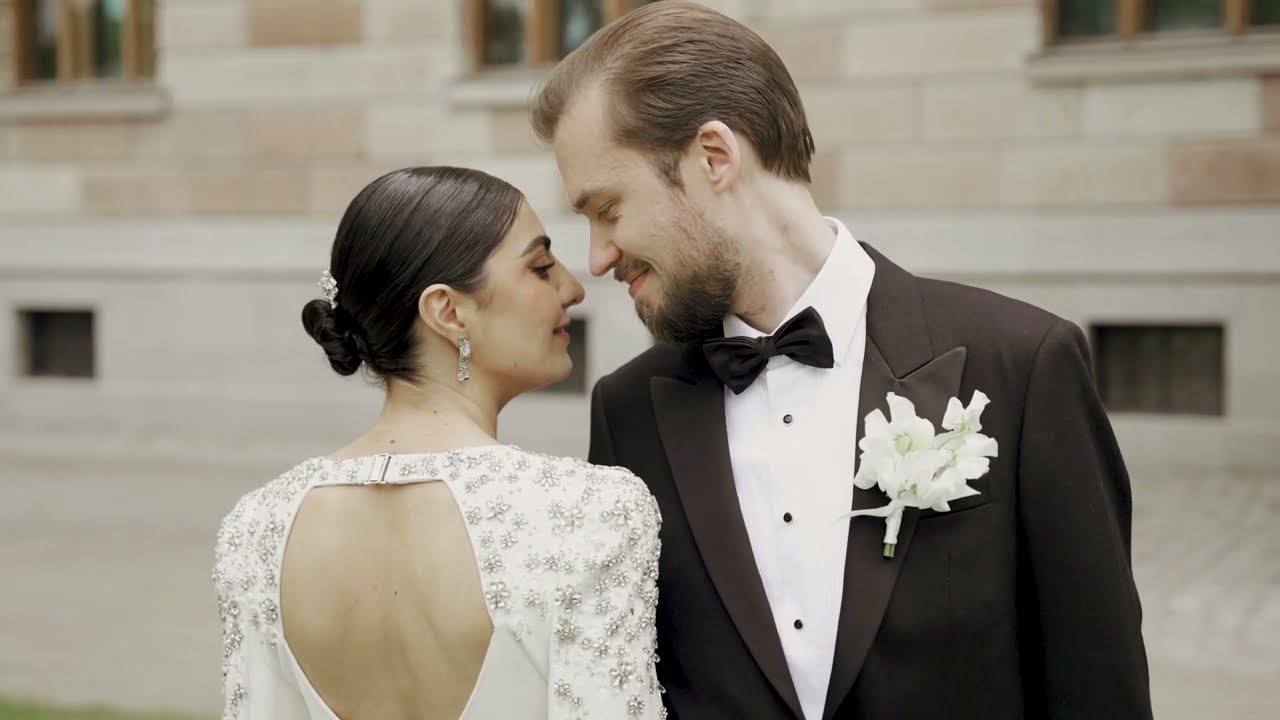
Wedding film at Nationalmuseum: height, stone and reflected daylight
Nationalmuseum is a museum first, which shapes the film in a way that is mostly good and occasionally awkward. The central space is tall, and daylight arriving from high above arrives soft and from directly overhead. Overhead light is kind to rooms and less kind to faces, since it puts shade under the brow and the nose. The practical answer is to stand people where the light has bounced off a pale wall on its way down, so that some of it comes in horizontally as well.
What the height gives back is scale. Two people at the bottom of a very tall room read as small, and small reads as human. A wide frame held for six or seven seconds with a couple crossing the floor is one of the few shots that works in a museum and nowhere else, because almost no other wedding venue has that much empty vertical air above a ceremony. Staircases matter here too. A stair gives a camera a rising or falling line to follow, and in a building with a monumental one, the walk itself becomes a scene rather than a transition.
The awkward part is stone. Hard floors and hard walls in a tall volume produce a long reverberation tail, and the taller the room the longer it runs. A vow spoken into that space and picked up from ten metres away is close to unusable. We work with microphones placed on the people speaking and on the officiant, and we treat the room sound as atmosphere rather than as the source of the words. Guest applause in that kind of space is enormous, which is useful in the edit as long as it is not sitting on top of a sentence you need.
The other thing to plan for in a museum is movement. Art spaces have rules about where equipment goes, how close anyone stands to the works and whether floors can be crossed during opening hours. Those rules vary and they change, so we ask rather than assume, and we build the shot plan after the answer rather than before it. The current terms are published by the venue on the official Nationalmuseum site.
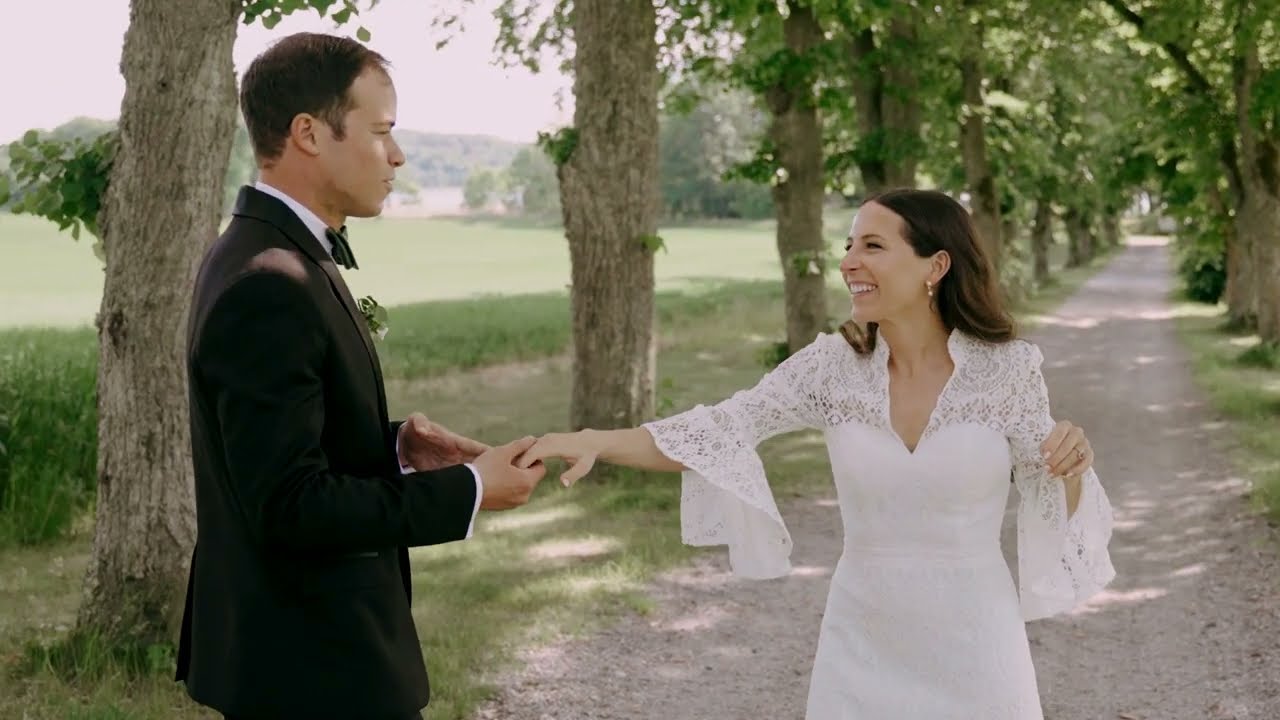
Wedding film at Häringe Slott: dark wood, small windows and long evenings
Häringe Slott is the opposite problem to a museum. It is a country house south of Stockholm with the proportions of a house rather than a hall: heavy timber, panelled walls, deep window reveals and rooms that are wide rather than tall. Light comes in through window openings set into thick walls, which means it arrives as a defined shaft rather than as general fill, and it falls off sharply a couple of metres in.
That is a difficult room to light and a very good room to film in, because the fall-off does the work that a lighting rig would otherwise have to do. A person standing one step inside a window is separated from a dark background without anything being added. A person standing three steps further in is in near darkness. So the whole practical craft at a house like this is knowing which side of that line to put the camera, and asking for portraits and first looks to happen near the openings rather than in the centre of the room.
Dark wood also absorbs sound, which makes speeches around a long table far easier to record than the same speeches in a stone atrium. The trade is that a house with low ceilings and full tables has very little floor for a camera to stand on. There is often one route around the table and no second angle, so covering a toast means choosing a side before it starts and staying there. We plan the dinner coverage in advance for exactly that reason.
The grounds are the release valve. A house set in open land gives you somewhere to take twenty minutes at the end of the afternoon, when the low sun rakes across grass and treeline and does in one pass what no interior in the building will give you. In midsummer that window is very long and it stays soft for hours, which is why a wedding videographer Stockholm couples brief properly will usually ask to hold a short slot late in the evening rather than only around the meal. Venue facts belong with the venue, and those are on the official Häringe Slott site.
Sound and reverberation in large halls
Almost everything that goes wrong with a wedding film goes wrong in the audio, and almost all of it is decided by the room. Reverberation is simply sound arriving at the microphone more than once, first directly and then again after bouncing off walls, floors and ceilings. The larger the room and the harder the surfaces, the longer the gap between the first arrival and the last, and the more the words smear into each other.
There is no post-production fix that fully removes it. Software can reduce a reverberation tail, and it will also thin out the voice while it does so. The only real solution is distance: a microphone close to the mouth hears mostly the direct sound and very little of the reflected sound, so the ratio comes out in favour of the words. That is why we put a recorder on the officiant and on whoever is speaking, and why a lapel that is under a jacket lapel rather than on top of it costs more in muffling than most people expect.
The second thing that helps is people. A full room absorbs far more sound than an empty one, because clothing and bodies are soft. A rehearsal in an empty hall will sound dramatically worse than the ceremony itself, which is worth knowing before anyone panics the night before. The third is ventilation. Large halls move a lot of air, and air handling produces a low continuous hum that sits under everything and is very hard to remove afterwards. If a room can be switched to a quieter setting during vows, it is worth asking.
Outdoor ceremonies trade reverberation for wind, which is a better trade most of the time but not always. Wind noise on a lapel microphone is unusable rather than merely poor, so outdoor vows need wind protection on every capsule and a backup recorder somewhere sheltered.
What to ask the venue before you book film
Most venue questions couples ask are about capacity, catering and cost. Those matter and they say almost nothing about how the day will film. The questions that change the film are narrower and easier to answer, and any venue coordinator can answer them in a single email.
- Which direction do the main windows face, and at what time of day does direct sun reach the ceremony room?
- Where can a camera operator stand during the ceremony, and is there a second position at the back or to the side?
- Are there rules about tripods, lights, equipment cases or filming in specific rooms?
- Can a small microphone be attached to the officiant, and is there a house sound system with an output we can record from?
- Is there a quieter ventilation setting available during the ceremony and the speeches?
- What is the earliest we can be in the room to see it empty, and can we walk it before the guests arrive?
- Is there outdoor space we can use late in the evening, and is it accessible after the meal starts?
We ask these on your behalf as part of planning, so you do not have to translate them. If you want to compare what different approaches actually cost before you get that far, the cost guide for wedding film in Sweden sets out the numbers in plain terms. Talking to a wedding videographer Stockholm couples already trust at the venue-choosing stage rather than after the booking is almost always cheaper, because the schedule can still move.
How the timeline and the light fit together in each room
A timeline is a lighting plan whether anyone calls it that or not. Every hour you move an event, you move it into different light, and in Sweden the spread across the year is extreme. A June wedding has usable daylight until close to midnight. A late September wedding loses the sun before dinner is served. The same room in the same building behaves like two different rooms depending on which of those you are planning.
In a hotel with large windows, the useful hours are the ones when the sun is off the glass rather than straight through it. Direct sun through a tall window produces very hard shapes on the floor and blown highlights on skin. An hour either side of that is soft and even. So for getting ready we look for the side of the building that is in shade at that hour, and that is usually a room choice rather than a time choice.
In a tall museum space with light from above, the room changes less across the day than you would expect, because the light is already diffuse by the time it reaches the floor. That makes scheduling easier and it also means there is no golden hour indoors. If you want warm low light in the film, it has to come from stepping outside or from what the venue turns on after dark.
In a country house with deep windows, the timeline is the single biggest variable in the film. Interiors go dim early, and once they do, the day belongs to whatever practical light is in the room: candles, sconces, table lamps. That is workable and it can be beautiful, but it is a different film from the one shot two hours earlier. The usual answer is to protect a short outdoor slot in the evening and to accept that the interior material after dark will be warmer, grainier and closer in.
| Venue | Light character | Sound behaviour | Camera positions | Best for |
|---|---|---|---|---|
| Grand Hôtel | Large windows, bounced light off the water, high contrast against dark interiors | Carpet and soft furnishing absorb well, full ballrooms are manageable | Corridors, stairs and landings give many transitional positions | Best for films built on movement between rooms and on window light in the getting-ready hours |
| Nationalmuseum | Overhead daylight, diffuse, steady across the day, little variation indoors | Hard stone and great height, long reverberation tail, loud applause | Wide floor and vertical space, monumental stair, museum rules apply | Best for films that use scale, height and wide held frames around the ceremony |
| Häringe Slott | Deep window reveals, sharp fall-off, dark panelled interiors, long evenings outdoors | Wood and fabric absorb sound, speeches at the table record cleanly | Limited floor space at dinner, often a single usable side per toast | Best for close, warm films where the grounds carry the evening light |
A filmmaker’s perspective
My name is David Backlund, and I film and edit every Nordvér wedding myself. My background is in documentary and narrative film rather than in event video, and that is the reason I work the way I do: handheld, in natural light, without directing anyone and without asking for a moment to happen again. If it happened once, that is the version that goes in the film.
Working that way puts a lot of weight on the room, because the room is the only thing I am not controlling for. In a hotel I am reading corridors and thresholds and thinking about where someone will pause. In a museum I am thinking about how much air is above people and where I can stand still long enough for a wide frame to earn its place. In a house with small windows I am counting steps from the glass. None of that is visible in the finished film, which is the point.
The films run 5 to 8 minutes and follow the whole arc of the day rather than a montage of highlights, and they are delivered within 12 weeks. A full weekend film is available as an addition and is quoted per wedding. Nordvér was co-founded with the wedding photographer Karin Lundin, and photo and film can be booked as one team that has worked together many times. The film can also be booked on its own, and often is.
We take a small number of weddings each year because I edit all of them. If you have a date and a room in mind, or you are still deciding between two of them, write to us through the contact page and we will reply within 48 hours. Travel outside Stockholm is written into the quote rather than added afterwards.
Key takeaways
- Daylight direction matters more than daylight quantity. Ask which way the windows face and when direct sun hits the ceremony room, then place the getting-ready hours accordingly.
- Hard surfaces and height mean long reverberation. Vows in a stone hall need microphones on the people speaking, not on the camera, and no software fully removes a reverberation tail afterwards.
- Camera positions are decided by architecture. Corridors and stairs give a film movement, a full dinner table usually gives you one side and one angle for the whole toast.
- Dark panelled rooms with deep windows create separation for free, but the usable zone is a step or two from the glass and everything past it is in near darkness.
- The timeline is the lighting plan. Moving dinner an hour changes the film more than changing the camera does, and in autumn it changes it completely.
- Ask the venue the seven practical questions above before signing, while the schedule can still move. After the booking, most of those answers are fixed.
Frequently asked questions
Does a dark venue mean we need extra lighting for the film?
Usually not. We film in natural and existing light, and modern cameras handle low light well. What a dark room actually costs you is not brightness but separation, so the answer is to place people near whatever light source the room has rather than to add one. In rooms that are dark after sunset, candles and lamps become the light, and the film simply gets warmer and closer in.
How do you record vows in a hall with a lot of echo?
With microphones placed close to whoever is speaking, usually on the officiant and on one or both of the couple, plus a recording from the house sound system where the venue has one. The room sound is then used as atmosphere rather than as the source of the words. Recording vows from a camera position ten metres away in a reverberant hall does not produce usable speech.
Which of these three venues films best?
None of them ranks above the others. They give different films. A hotel gives movement and window light, a museum gives scale and height, a country house gives warmth and grounds. Choose the room you want to spend the day in and the film will follow it honestly.
What does a wedding film cost in Stockholm?
A wedding film with Nordvér starts at around 45 000 SEK, about 4 000 EUR, and prices for private clients include VAT. In our experience a professional videographer in Sweden starts at around 35 000 SEK. A full weekend film is available as an addition and is quoted per wedding, and travel is written into the quote.
How long is the finished film and when do we get it?
The highlight film runs 5 to 8 minutes and covers the whole arc of the day rather than a set of disconnected moments. Delivery is within 12 weeks. David films and edits every film himself, so nothing is passed to an outside editor.
Can we book photo and film together?
Yes. Nordvér was co-founded with the wedding photographer Karin Lundin, and photo and film can be booked as one team that already knows how the other works, which matters most in tight rooms where two people have to share the same sightline. The film can also be booked on its own.
How early should we talk to a wedding videographer?
Before the venue is locked in if you can, because that is when the schedule is still movable and the room questions can still change something. Practically, we take a small number of weddings each year and reply within 48 hours, and summer dates are booked first, so earlier is safer for availability as well.
Do you film outside Stockholm?
Yes. We film across Sweden and abroad, including weddings in Verbier in Switzerland and Praiano on the Amalfi Coast. Travel is always written into the quote rather than added afterwards.